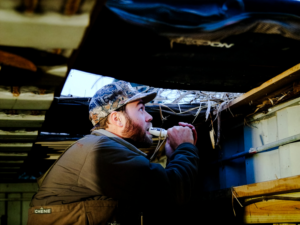
Spencer Parker keeps his eyes on target while guiding waterfowl hunts.
A true wildlife enterprise journey
It’s been all focus and feathers for Auburn University alumnus Spencer Parker since graduating from the Plains. Transforming a lifetime’s passion into a career in guided hunting and shooting sports changed the trajectory of his life, allowing for unique professional growth, critical thinking and fun. Today, he leads others in experiencing their own outdoor passions while providing top-tier hospitality and expertise. Parker says that if it wasn’t for Auburn, his journey might have looked significantly different.
Enjoying the chase
Growing up in Decatur, Alabama, Parker was intrigued by the outdoors. He could normally be found outside during most of his childhood, participating in family activities, sports and his high school bass fishing team. Utilitarian skills such as operating heavy equipment and performing mechanical maintenance were instilled at a young age and have proven to be evergreen in value post-higher education. The more time he spent in nature, the more curious he became. Like an engineer wonders how something is created, Parker thinks about wildlife ecosystems in a similar vein.
“I have a craving for knowledge about how the natural world works—how plants and animals interact with each other to make ecosystems function,” Parker said. “When I enrolled in the Wildlife Enterprise Management (WLEM) program, it fueled the fire inside me to learn as much about wildlife and native habitat as I could, while imparting those principles in the field to others to enhance their experience.”
Parker was originally enrolled at Auburn to study business management. His heart felt strongly that he was destined for an adjacent path, and he found the WLEM program within the College of Forestry, Wildlife and Environment (CFWE). The WLEM major is one of the few cross-disciplinary programs in the nation founded on the principles of wildlife management, hospitality services and business management. Collaboratively instructed by the CFWE, Auburn’s Harbert College of Business and College of Human Sciences Horst Schulze School of Hospitality Management, graduates of this premier program depart Auburn prepared to begin abundant careers at worldwide facilities focusing on hunting, fishing and wildlife-based recreation while also providing hospitality and business portfolio management.
Talking the talk
The WLEM curriculum’s multidisciplinary coursework is robust and provides a trifecta of real-world knowledge from the three collaborating Auburn units. In the CFWE, coursework ranges from wildlife classes in Mammalian Ecology & Management to skill-and-safety subjects in Sporting Firearms & Archery.
“You would be surprised how many people in the outdoor industry have very little understanding of basic habitat requirements for wildlife, wildlife biology and general habitat management,” Parker said. “I believe that it is the responsibility of good habitat managers to provide data and research, backing up what you are doing and why. It is very important to be well-versed in academic literature so that you can explain and implement practices that improve wildlife habitat. We are in a new era where we do not have to rely on ‘what Grandpa said’ or ‘this is how it has always been done.’ There is so much great research going on across all fields of study. Use it to your advantage.”
Parker recalls receiving excellent instruction and advice from CFWE faculty, including Stephen Ditchkoff, Will Gulsby, Janna Willoughby, Mark Smith and others. Their guidance offered applied science opportunities through site visits and field trips, providing science-based knowledge and invaluable career advice based on decades of combined professional experience.
“They made going to class easy for me as I genuinely wanted to learn more from them because of the passion they have for their areas of expertise,” Parker said. “It was contagious. I highly recommend students take advantage of their knowledge and experience while they can. The faculty truly want to see you succeed and are willing to help any way possible.”
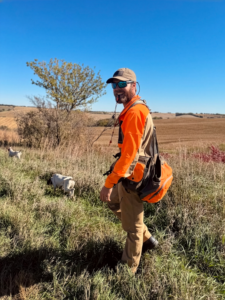
Parker utilizes dogs while guiding hunts at Pheasant Bonanza.
Walking the walk
Parker’s most recent role as a shooting sports manager at the award-winning Pheasant Bonanza Hunt Club & Kennel located in Tekamah, Nebraska, has provided numerous invaluable experiences. This Orvis-endorsed facility features more than 5,000 acres of habitat for deer, turkeys, ducks, pheasants, geese and fish plus areas and spaces designated for clay and trap shooting, rifle and pistol ranges and event spaces for weddings, corporate events and lodging. Pheasant Bonanza was recognized as the Orvis Wingshooting Lodge of the Year in 2025.
As shooting sports manager, Parker is tasked with maintaining the annual operation and maintenance of the Pheasant Bonanza’s shooting sports assets. Year-round, Parker fulfills a multitude of responsibilities to ensure the facility delivers unparalleled experiences for its clients, with its resources at the center.
“Being a guide at Pheasant Bonanza, you can expect to lead hunts for well over 100 days per year,” Parker said. “This includes training, conditioning and taking care of dogs, preparing waterfowl blinds and fields, scouting and placing blinds for deer hunters, transporting clients to and from airports and, most importantly, ensuring that clients have a great experience in the field. There is almost no such thing as a typical day in my role as new challenges arise constantly, and with hunting season changes, almost no two days are the same.”
Parker emphasizes that no element is more critical to defining success in the WLEM program than experience. Gaining hands-on opportunities early in the program has played a pivotal role in advancing his professional journey. He notes that being able to showcase tangible work from prior experiences is invaluable when pursuing future employment opportunities.
“Your professors have probably mentioned this at some point but get experience as soon and as often as possible,” Parker said. “It helps tremendously when you are applying for positions to pull from your previous experiences. It is hard to do that if you do not have any. Go on outdoor adventures in your free time. Go boating, hiking, camping and hunting in new areas. All these activities may be recreational, but they can help create valuable skills and experience that can translate to this industry.”
Parker also implores all CFWE students, especially WLEM majors, to brush up on applicable field research.
“Be ready to back up your management plans with research,” he said. “If you are in charge of managing habitat, you should be able to cite and reference peer-reviewed literature to back up what you are doing and why. Stay up to date on the latest research involving your specific region’s habitat and wildlife trends for management purposes. It helps to also have a good understanding of wildlife biology, so that you can explain habitat requirements for each of the species of game you are managing for and implement them.”
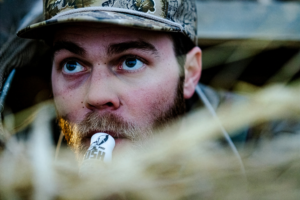
Parker holds his focus during a waterfowl hunt.
Setting the standard
“Spencer represents the best of us,” said Dylan Thomas, WLEM professor of practice. “I have had the pleasure of working side by side with him in the industry. His knowledge, honesty and work ethics are impressive to say the least. Spencer leaves a good impression on everyone he interacts with from employers to clientele, which shows his ability to read people and produce the desired outcome and experience.”
The difference between Auburn graduates and those of peer institutions is the variety of education that CFWE students receive. Parker adds that a unique component of Auburn’s WLEM program is its focus on providing world-class experiences to clients.
“Do not take for granted the hospitality portion of this major,” he said. “It is extremely important. No matter what area of this industry you intend to work in, dealing with people is one of the most important parts of the outdoor industry. I use a lot of knowledge gained from habitat management and wildlife biology courses, but all of that can be for naught if you cannot create and maintain professional relationships with people.”
Parker explains that soft skills are invaluable when providing professional guidance or sharing opinions with stakeholders and clients who may lack wildlife expertise. Likewise, Parker notes that simply sharing a nice compliment or gesture can transform a client interaction into a long-term professional relationship. Regardless of the situation, the training and mentorship acquired at Auburn are setting the standard for career success in its WLEM program.
“I learned very quickly after I graduated and met students in similar majors from other universities that Auburn truly is special because of our faculty and staff who are leaders in the outdoor and wildlife research community,” Parker said. “If you are thinking about joining the WLEM program, consider what you want your work life to be like after college. I was always told ‘do what you love, and you’ll never work a day in your life.’ That rings true in this industry for me personally and if you like working outside with wildlife and in wild places, it may be true for you as well.”
Today, Parker’s journey in wildlife enterprise continues to advance as his experience and knowledge recently earned him a new role as a general manager at a private cooperative retreat in Florida.