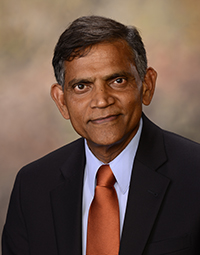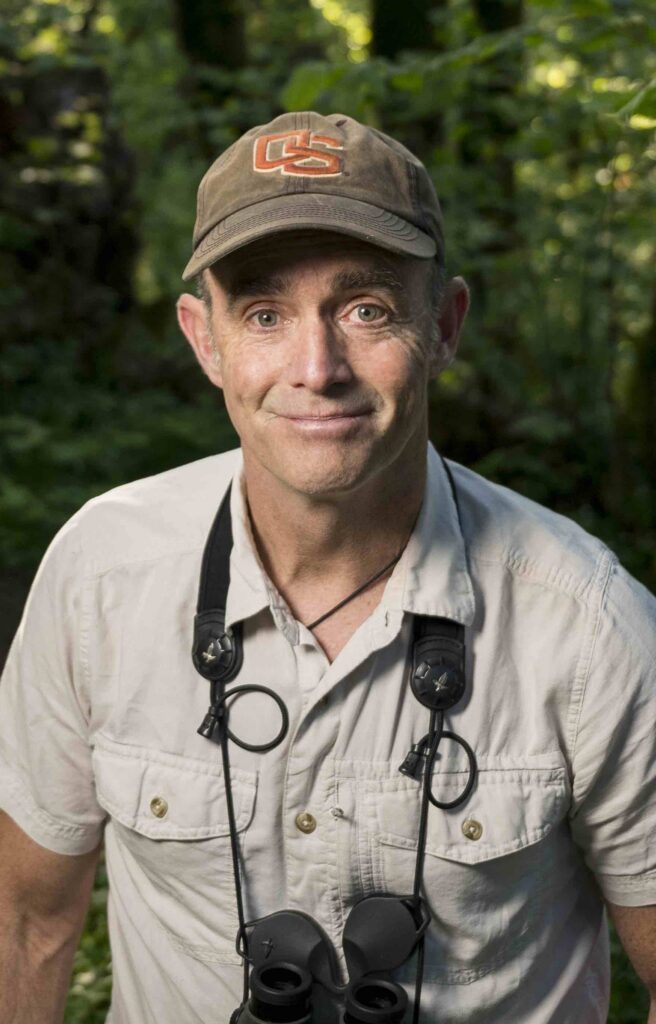
Matthew Betts, the Ruth Spaniol Chair of Natural Resources Conservation in the Department of Forest Ecosystems and Society at Oregon State University.
The Auburn University Weaver Lecture Series will present a talk by Matthew Betts, the Ruth Spaniol Chair of Natural Resources Conservation in the Department of Forest Ecosystems and Society at Oregon State University, on Thursday, April 9, at 2 p.m. at the College of Forestry, Wildlife and Environment (CFWE).
Betts’ novel research has helped identify behavioral adaptations in plants, the relative importance of social information in animal habitat selection and how disturbances occurring over evolutionary timescales affect the global distribution of species sensitive to fragmentation.
He is considered a preeminent scholar in the field of landscape planning, highlighting the impacts of forest loss and degradation on biodiversity worldwide, and has pioneered the integration of niche and landscape theory to better understand species-specific responses to anthropogenic changes.
Summarizing 18 years of research, Betts’ lecture titled “Can we have our cake and eat it too? Conserving forest biodiversity in an age of humans.” will examine how forest management affects biodiversity across local, landscape and global scales. Further, Betts will address the broader question of how to satisfy global wood demand at the least cost to biodiversity and the climate.
As a leading expert in landscape ecology, focusing on how forest management and climate change impact biodiversity and ecosystem functions, Betts has authored over 150 peer-reviewed publications (including in the journals Science and Nature). His work has been profiled in the New York Times, Washington Post, National Public Radio, CBC, National Geographic and Scientific American.
Currently, Betts is the lead investigator for the Oregon Intensive Forest Management project, lead scientist for the H.J. Andrews Experimental Forest Long-Term Ecological Research (LTER) Program and the founder and director of the Oregon State University Forest Biodiversity Research Network. His work is primarily funded by the National Institute for Food and Agriculture and the National Science Foundation.
During his lecture, Betts will describe his research team’s 15-year experiment focused on intensive forest management, timber production and biodiversity, their long-term study on the role of forest structure (particularly old growth) in dampening the effects of climate change on bird populations and the influence of forest loss and fragmentation on tropical biodiversity.
“Operating at the intersection of habitat management, forestry and biodiversity conservation, Dr. Betts advocates for supporting human societies while maintaining ecosystem services and functions through the responsible production of forest products,” said Alavalapati. “As such, his work is of significant importance to a diverse cross-section of Auburn faculty and students, and we are grateful that he will share these insights with our academic community.”
The Weaver Lecture Series was established in May 1996 through an endowment provided by Earl H. and Sandra H. Weaver. The series brings experts in various research areas relevant to forestry, wildlife and the environment to the Auburn campus to enhance the college’s academic programs through public lectures and interactions with faculty and students.
The lecture is open to the public and will take place on Thursday, April 9, at 2 p.m. at the Forestry, Wildlife and Environment Building at Auburn University. A reception will be held immediately following the lecture at 3 p.m. Pre-registration is not required for attendance.
For details about the Weaver Lecture Series and to review Betts’ bio and lecture abstract, visit the CFWE events calendar.