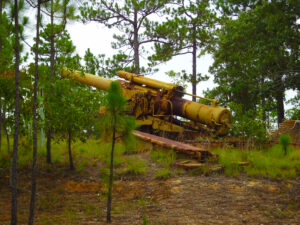
A decommissioned artillery cannon rests in a forest.
The mission
Supporting the United States military has been the mission-critical purpose of Auburn University’s Center for Natural Resources Management on Military Lands (CNRMML). Since its inception in 2022, the center has established a model partnership with military installations that is redefining how public universities support the military’s operations and conservation priorities. In 2026, the CNRMML is now expanding its services to meet the diverse and growing needs of its partners while bolstering the outreach mission of the Auburn College of Forestry, Wildlife and Environment (CFWE).
Fulfilling a need
The Department of Defense (DOD) is the country’s fifth-largest landowner, overseeing more than 8.8 million acres of property. Within these sites are water bodies, forests and wildlife habitat, many of which exist in proximity to the military’s installations and operational areas, requiring significant management expertise to address natural resource issues and ensure compliance with regulatory policies. As one can imagine, it literally takes an army to efficiently manage these lands so that the DOD can sustain operational training, testing and research.
More than a decade ago, in 2013, Congress authorized the establishment of Intergovernmental Support Agreements (IGSAs) for U.S. military branches to partner with state, local and tribal governments for installation support services. The goal of this legislation was to reduce costs and enhance mission effectiveness.
Three years later, Auburn and Fort Benning, Georgia, a local installation of the U.S. Army, signed an IGSA to supply ecological monitoring services. Then in 2022, Auburn and the U.S. Army solidified this partnership by signing a historic, 10-year Regional Intergovernmental Support Agreement (RIGSA) to provide natural resource management services to eight military bases across the southeastern region of the U.S., including Redstone Arsenal and Fort Rucker in Alabama; Forts Benning, Gordon and Stewart in Georgia; Fort Polk in Louisiana; Fort Bragg in North Carolina and Fort Jackson in South Carolina. To facilitate these services, the CNRMML was created in the CFWE to be the administrative arm to fulfill these agreements through the Army’s task orders.
“The mission of the CNRMML is to assist and enhance natural resource management programs on U.S. military installations while concurrently creating research, education and outreach opportunities for Auburn,” said George Matusick, the CNRMML director. “We aim to bridge the gap that currently exists between natural resource managers on military lands and natural resource management education and research. Our vision is to emerge as the preeminent resource for natural resource managers on U.S. military installations.”
Shortly after the CNRMML’s establishment, the RIGSA agreement was expanded. Now more than 50 U.S. Army installations in the continental U.S. can secure services through the Auburn RIGSA agreement.
“The initial expansion allowed us to work collaboratively with several installations that were interested in working with us but were not named in the original agreement,” Matusick said. “This was critical for expanding partnership opportunities outside the southeastern U.S.”
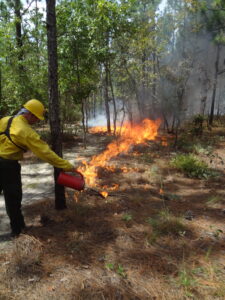
Forestry technicians conduct a prescribed burn.
The CNRMML has grown exponentially with the scope of its ecological services that include prescribed burning, GIS mapping, wild game management, tree planting and site preparation, non-native invasive species control, threatened and endangered species surveys and monitoring. To facilitate this growth, Auburn hired and placed full-time employees at installations such as Fort Benning, fully integrating Auburn within IMCOM’s land management systems.
Beyond expanding its footprint, the center’s success is largely due to Matusick and his team’s efforts to improve access to services for military resource managers. Toward this end, the team has worked closely with Auburn to streamline the acquisition and fulfilment process, making it easier and more efficient for managers to receive this support.
At Fort Benning, the CNRMML facilitates the installation’s conservation goals and land management through its partnership with the Natural Resources Management Branch (NRMB), a group responsible for the overall management of military lands.
“The RIGSA is a highly effective tool for managing Army natural resources, cutting administrative execution time by an average of 35% compared to traditional contracts,” said James Parker, chief of Fort Benning’s NRMB and an Auburn alumnus. “Working with George and the Auburn University team provides Fort Benning with a reliable partnership and cost-efficient services.”
In some cases, the CNRMML staff will secure third-party contractors to provide services requiring specialized equipment or technical capabilities. In the past, this process could potentially be cumbersome for military installations because of numerous bidding processes, vetting protocols and communication between vendors. Now, with CNRMML managing these services, whether directly or through contractors, from start to finish, the center is helping fulfill each installation’s unique needs.
“We have the ability to acquire services from a wide range of private companies, state and local governments, non-profit organizations and other universities, which allows us to find the best-positioned service provider for our military partners on any given task,” Matusick said.
Expanding service horizons
Military installations are complex and contain numerous features, facilities, amenities, structures and training areas that support their operations and personnel. Although the RIGSA between Auburn and the U.S. Army originally focused on natural resource-related services, the CNRMML has recently expanded to include environmental compliance, architecture and engineering services.

John Richards and Brandi Boutwell
To oversee these endeavors for their clientele, the center recently welcomed two new assistant directors to its leadership staff, John Richards and Brandi Boutwell. Richards, a U.S. Marine Corps veteran and two-time Auburn alumnus, will focus on developing a program capable of supporting military partners with services to maintain compliance with the Clean Air Act, Clean Water Act, National Environmental Policy Act and many other federal, state and Army-specific laws and regulations. Boutwell, a registered architect, Auburn alumna and holder of a National Council for Interior Design Qualification certification, is tasked with developing a program capable of supporting military partners with services to maintain and upgrade infrastructure, including buildings, bridges, roadways and more.
“John and Brandi’s expertise will allow the CNRMML to provide this critical set of services that allows our military partner installations to function and ensure mission sustainability,” Matusick said.
A third expanded horizon for the center’s services will include cultural resources management. The U.S. Army manages more than 4,000 historic buildings, 54,000 archaeological sites, 17 National Historic Landmarks and 31 sacred Native American sites. Without proper guidance on legal, ethical and scientific preservation of historical sites, artifacts and culturally significant landscapes, operations and research can quickly be halted at the Army installations.
As the CNRMML expands the breadth of its impact and reach, it remains committed to strengthening its services to ensure the high-quality assistance its clients have come to expect continues to be the standard.
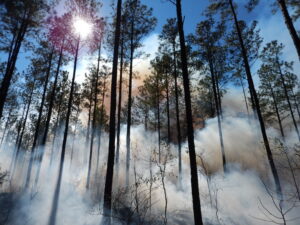
A prescribed burn lifts smoke across the understory of a pine forest.
Leading the charge
One of the most important goals of the CNRMML is to be an example of what is possible through intergovernmental partnerships. As an R1 research institution, the military gains access to Auburn’s technical expertise and state-of-the-art resources to ensure the optimal success of its task orders. Outreach and extension are also an integral part of the university’s land-grant mission, and the center provides new and impactful opportunities to engage the military through this partnership.
A small fraction of state academic institutions are utilizing this relatively new congressional authorization. The rapport that the CNRMML has built with the U.S. Army has allowed the center to lead the charge of forging new relationships with the federal government while also securing important sources of extramural funding, which have become scarcer in recent years.
Matusick says that in 2025, the CNRMML secured approximately $5.4 million in funding for the fiscal year. This amount has increased year over year, providing beneficial revenue sources for the CFWE and the university.
“Expanding the volume and types of services we provide is increasing the number of partnership opportunities, our impact on the management of military lands and extramural funding to Auburn University,” he said.
Incorporating experiential learning opportunities for undergraduate students is also a priority of the CNRMML. For the first time this year, the center conducted a student field trip to a military installation. The CNRRML staff, along with host partners at Fort Benning, facilitated a day-long exhibition of NRMB operations, led by Chief Parker. Students gained invaluable hands-on learning and perspective about military lands management while witnessing prescribed fire demonstrations, a gopher tortoise relocation into native habitat, red-cockaded woodpecker habitat management in pine forests and technical equipment operations.
Serving those who serve
The CNRMML aims to continue taking its mission to the far reaches of the nation, leveraging its expertise and resources with the successful execution of DOD partnerships. In less than 5 years, the center has formed impactful partnerships with installations throughout the eastern United States, serving those who serve while forging professional and reliable relationships with the U.S. military.
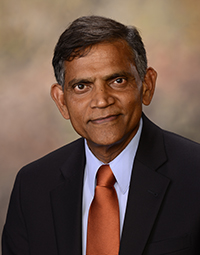
“The CNRMML exemplifies the forward-thinking partnerships that define Auburn’s land-grant mission,” said Janaki Alavalapati, the CFWE’s Emmett F. Thompson Dean. “In only a short time, the Center has established itself as a trusted partner to the U.S. military by delivering innovative, efficient solutions that support both mission readiness and natural resource stewardship. As the Center expands its services and reach, we see tremendous opportunity to further elevate Auburn’s impact, create meaningful experiential learning opportunities for our students and continue serving those who serve us with excellence well into the future.”