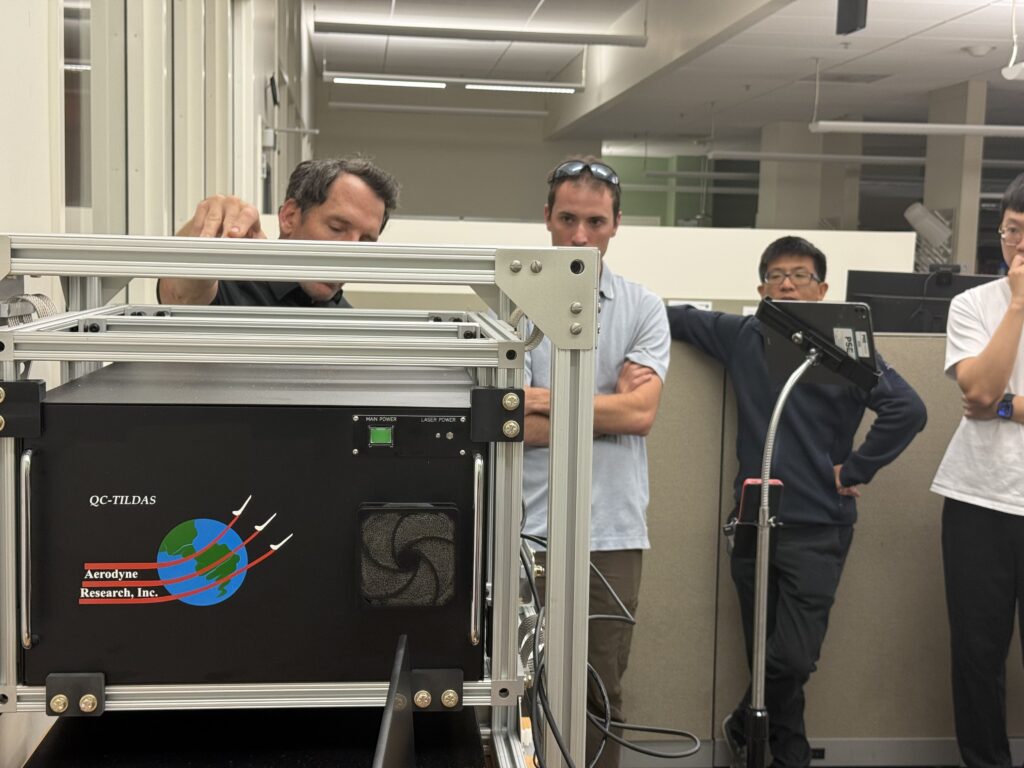
Researchers at Stanford University test the Aerodyne Tildas hydrogen analyzer, the world’s first commercialized H2 analyzer, used in the lab to measure atmospheric hydrogen concentrations. (Photo credit: Rob Jackson, Stanford University)
Hydrogen holds promise as an alternative energy source that will play an important role in decarbonizing the global energy system, potentially fueling our industrial production, homes, commerce and infrastructure one day.
However, scientists warn there is reason to be cautiously optimistic. Hydrogen (H2) interacts with methane, ozone (pollution) and water vapor in the atmosphere in ways that may warm the climate, thereby potentially negating its benefits.
A new study co-led by an Auburn University researcher and recently published in the esteemed scientific journal Nature suggests that embracing a “hydrogen economy” will require a deeper scientific understanding of the global hydrogen cycle to support a climate-safe, sustainable hydrogen economy.
Unlike greenhouse gases, including carbon dioxide and methane, hydrogen itself does not trap heat in Earth’s atmosphere. Through interactions with other gases, however, hydrogen indirectly heats the atmosphere roughly 11 times faster than carbon dioxide during the first 100 years after release, and approximately 37 times faster during the first 20 years.
Unintended consequences
“This indirect warming raises concerns about the climate consequences of potential hydrogen leakage, and highlights that the climate benefits of a future hydrogen economy will depend on minimizing leakage through the hydrogen value chain and reducing natural gas (methane) emissions,” said Zutao Ouyang, leading author of the study and assistant professor of ecosystem modeling in Auburn’s College of Forestry, Wildlife and Environment (CFWE).
To assess the impact of this leakage, Ouyang collaborated with an international consortium of scientists known as the Global Carbon Project to develop the first comprehensive accounting of global hydrogen sources and sinks, assessing changes in atmospheric hydrogen and their climate consequences.
The study, “The Global hydrogen budget,” was co-led by Ouyang and Rob Jackson, Stanford University professor and chair of the Global Carbon Project, in collaboration with researchers from approximately 30 international institutions from France, Australia, China, Japan, the United Kingdom, Norway and Austria.
“The team collected direct measurements of hydrogen in the atmosphere, along with the most comprehensive ever data collection and modeling to estimate the major sources and sinks of hydrogen and produce a first-of-its-kind global picture,” said Pep Canadell, the executive director of Global Carbon Project, and chief research scientist at CSIRO Environment, Australia.
After, they projected future hydrogen emissions, removals and atmospheric levels under different scenarios of the Intergovernmental Panel on Climate Change (IPCC), using a simplified Earth system model to estimate how these changes could affect the climate.
Since hydrogen production began to increase 30 years ago, researchers estimate that atmospheric hydrogen concentrations have increased by about 70% from preindustrial levels through 2003, then briefly stabilized before rising again around 2010. The authors found that this increase is largely due to leakage from increased hydrogen production and, surprisingly and less well known, to hydrogen formation from the oxidation of increasing methane emissions from human activities.
Methane (CH4) emissions—especially from fossil fuel extraction, distribution and use—have an important, but often under-appreciated, influence on atmospheric hydrogen. Methane and hydrogen share the same pathway by which they are cleaned or oxidized in the atmosphere. Because methane oxidation itself produces hydrogen, this creates a feedback loop that can raise atmospheric hydrogen concentrations when methane emissions increase, further competing with the detergent that cleans the atmosphere of methane.
Though the overall climate effects are currently relatively small, these complex interactions have the potential to undermine the positive effects of hydrogen.
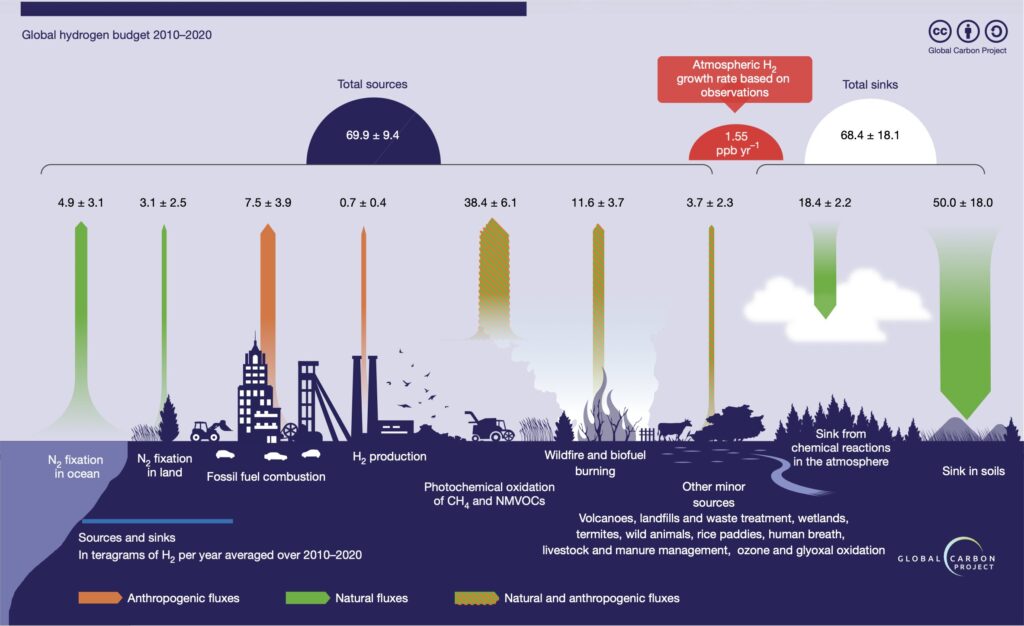
The global hydrogen budget provides the world’s first comprehensive accounting of global hydrogen sources and sinks, enabling an assessment of changes in atmospheric hydrogen and their climate consequences.
Calculating the risks
“The largest source of hydrogen in the world is the oxidation of methane in our atmosphere,” said Jackson. “But methane and hydrogen also compete for atmospheric cleansing detergents. This competition extends methane’s lifecycle in the presence of hydrogen, thereby increasing indirect climate warming. More hydrogen means more methane, and more methane means more hydrogen.”
The authors agree that for a hydrogen economy to become widely accepted, the unintended warming-driven interactions between hydrogen and methane must be minimized to build trust in hydrogen as a viable decarbonization pathway.
“By quantifying the previously unaccounted warming feedback between hydrogen and methane that are missing in current climate projections, we hope to improve future climate scenarios and support decision-makers in minimizing both economic losses and climate risks associated with hydrogen leakage,” said Ouyang.
Driving solutions
With this research in hand, policymakers, industries and researchers are equipped with the quantitative evidence needed to set safe hydrogen and methane leakage thresholds, craft effective regulations and prioritize cost-efficient mitigation strategies.
“The significance of this international study cannot be overstated,” said Janaki Alavalapati, the Emmett F. Thompson Dean of the CFWE. “The team’s comprehensive assessment of hydrogen sources and sinks, and their associated warming impacts, can help ensure that the global expansion of hydrogen aligns with a climate-safe and sustainable energy transition.”
The research study was funded by the Gordon and Betty Moore Foundation, Stanford Doerr School of Sustainability, Stanford’s Global Methane Office and Auburn’s CFWE.