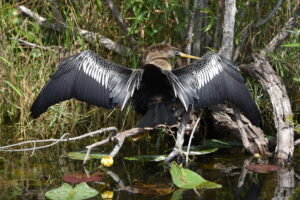
Cities house a wide variety of birds in their parks, including species like the anhinga (Anhinga anhinga). Photo by Christopher Lepczyk
Urban parks are a major feature of modern cities, offering places not only for recreation but also relaxation and opportunities to connect with nature and wildlife. Walk through any city park, and you’re likely to spot birds perched in trees, foraging on the ground, or even flying overhead. Beyond their value to people, a researcher at Auburn University’s College of Forestry, Wildlife and Environment (CFWE) is asking a more complicated question: how well do these spaces support wildlife?
Does the size of a park have a greater impact on biodiversity, or is it more important to have ample vegetation or open spaces?
Co-led by Christopher Lepczyk, CFWE Alumni Professor of wildlife biology and conservation, and collaborators Frank La Sorte of Yale University, Bertrand Fournier of the University of Potsdam, Jeffrey Clark of the Natural Areas Conservancy, and Myla Aronson of Rutgers University, the team set out to determine how different park features may affect the diversity of bird species across cities throughout the continental United States.
What they found challenges common beliefs. While larger parks do tend to support more bird species, size alone doesn’t tell the entire story. Instead, biodiversity depends on a combination of features, such as tree canopy, layout and the surrounding landscape. Those needs can vary depending on the region and time of year.
“There is no one-size-fits-all in terms of the features of parks that support bird diversity across the entire U.S.,” Lepczyk explained.
In fact, this study, recently published in Nature Cities, a rapidly rising journal within the prestigious Nature portfolio, was the first to examine park characteristics and biodiversity at this scale nationwide. It suggests that a network of different parks may be more effective than trying to design a single ‘ideal’ space. Some species may depend on dense tree cover, while others thrive in more open areas or smaller neighborhood parks.
“Different combinations of park features across multiple parks are needed to support all components of avian diversity across seasons,” Lepczyk said.
These findings show cities exactly what they can do to support wildlife. Rather than focusing only on building larger parks, planners and land managers can consider how existing parks function together. Adding or maintaining features such as tree canopies, plant diversity, or water could make even smaller parks more valuable for wildlife biodiversity.
With this information, city planners can better judge if their parks are not only supporting recreational opportunities for residents, but also serving as functioning, healthy ecosystems for the wildlife that share these spaces.
“Beyond birds, biodiversity plays an important role in urban environments by contributing to healthier ecosystems and improving quality of life for residents,” said Lepczyk, “Parks that support a wider range of species can also be more resilient to environmental changes.”
As cities continue to grow, the study suggests that supporting wildlife doesn’t require starting from scratch. With thoughtful planning and a mix of park types, urban areas may already have the tools they need to create spaces that work for both people and animals.
As cities continue to grow, the study suggests that supporting wildlife doesn’t require starting from scratch. With thoughtful planning and a mix of park types, urban areas may already have the tools they need to create spaces that work for both people and animals.