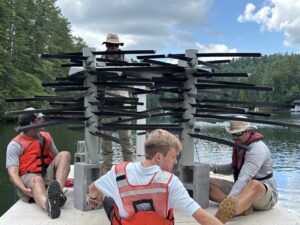
Evan Farry (center) assists the Georgia Power team in the field as an intern.
Evan Farry didn’t always see the landscape the way he does now. Growing up in Chelsea, Alabama, the forests, wetlands and rolling terrain of the Southeast were familiar, but it wasn’t until he arrived at Auburn University’s College of Forestry, Wildlife and Environment (CFWE) that those places began to tell a deeper story.
As a Geospatial Information Science major with a minor in Geography, Farry quickly discovered that maps were more than static images; they were living tools, revealing patterns and connections hidden beneath the surface. In the classroom and the field, he learned how data and technology could translate the natural world into something measurable, understandable and, ultimately, actionable.
One course, in particular, changed everything. In Forest Ecology, Farry found himself immersed in hands-on fieldwork walking through stands of timber, studying ecological relationships and beginning to see forests not just as scenery, but as complex, dynamic systems. It was a turning point that reshaped how he understood the environment around him.
Along the way, mentors made that journey even more meaningful. CFWE Associate Professor Lana Narine stood out, not just for her clear and engaging teaching style, but for the genuine care she showed her students. In her classroom, difficult concepts became approachable, and learning felt less like a task and more like a shared pursuit of understanding.
Farry’s student experience extended well beyond campus. As a natural resources and geographic information systems (GIS) intern with Georgia Power, he stepped into the real world of applied geospatial science, using GIS to tackle challenges tied to natural resources and utility systems. It was there that the connection between data and decision-making became tangible—where the skills he’d developed in class were put to work in meaningful ways.
Back at Auburn, he continued to deepen his experience through research. Whether assisting with data collection for a doctoral project on wetland fluxes or investigating how storm events impact southeastern ecosystems as an undergraduate research fellow, Farry found himself contributing to work that could shape how natural systems are understood and managed.
Now a CFWE alumnus, Farry looks ahead with a clear sense of purpose. He recently accepted a position in the public utility sector as a GIS analyst with Spire Inc., a large natural gas company in the United States, using geospatial tools to guide smarter, more informed environmental decisions.
For Farry, the journey has been about more than earning a degree; it’s been about learning to see the world differently, one layer of data at a time.