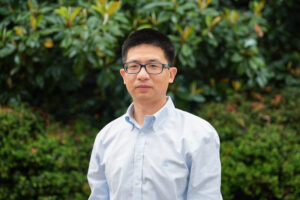
Zutao Ouyang
The Gulf region has a new champion at Auburn University to advance scientific knowledge of ecosystem health and community resilience.
Auburn College of Forestry, Wildlife and Environment (CFWE) Assistant Professor Zutao Ouyang is being recognized and supported for his early career advancements. An expert in ecosystem modeling, Ouyang has been named an Early-Career Research Fellow in the 2025-2027 cohort of the National Academies of Sciences Gulf Research Program (GRP). The 2025-2027 cohort features eight fellows focused on the GRP’s environmental protection and stewardships track, a project focus area that advances knowledge in scientific design, implementation and the evaluation of nature-based solutions, according to the GRP. Ouyang’s experience in ecosystem modeling is a strong expertise addition to an already stout research team, furthering the impact potential of the cohort.
“Our Early-Career Research Fellows are leading the way in applying science for the public good,” said Karena Mothershed, director of GRP’s Board on Gulf Education and Engagement. “Whether advancing nature-based solutions to strengthen ecosystems and community resilience or reimagining STEM education to foster a deeper sense of place, these fellows are applying their expertise to real-world challenges to create a bright future for the Gulf region.”
Ouyang leverages his geospatial and ecosystem modeling expertise to analyze and design natural resource management strategies and climate solutions. In recognition of the groundbreaking research Ouyang co-led with a team from Stanford University and other international institutions on global hydrogen and methane budgets, his work was recently published in the prestigious journals, Nature and Science.
Ouyang has also applied his expertise to advance academic instruction through the Geospatial Information Science major. One of the few programs offered in the Southeast, the Geospatial Information Science program brings together information technology, spatial science, data analysis, natural resources and ecological modeling to prepare students for in-demand technological careers where “Big data” drives decisions.
“I am honored to be selected as an Early-Career Research Fellow in the GRP,” Ouyang said. “This fellowship recognizes my research, and I am excited to join the GRP community and engage with fellow scientists, practitioners and policymakers working across disciplines to help urban green infrastructure that are not only effective under extreme and compound climate events, but also equitable and responsive to local needs.”
An independent program founded on science in 2013, the GRP’s mission is to “develop, translate and apply science to enhance the safety of offshore energy, the environment and the well-being of the people of the Gulf region for generations to come.” The GRP is a direct response to the Deepwater Horizon crude oil disaster in 2010, which inflicted more than $61 billion in economic and environmental damages. Since its inception, the program has devoted its resources and expertise to the progress of rebuilding this coastal region. Currently, the GRP has catalogued more than 90 projects and 490 events supporting the generation of lasting solutions to the Gulf.
Each fellow receives support from the GRP during the imperative pre-tenure chapter of their respective careers in the form of a $76,000 award and a mentorship network to assist with their professional research growth. With his new support, Ouyang is poised to contribute heavily to the continued success of the GRP.
“Dr. Ouyang represents the next generation of scientific leaders whose work bridges data science, ecology and decision-making,” said Janaki Alavalapati, the Emmett F. Thompson Dean of the CFWE. “His appointment to the GRP underscores the vital role Auburn plays in developing innovative solutions for the most pressing environmental challenges of our time. We are proud to see his work contributing to solutions that strengthen the health and resilience of the Gulf region.”
Ouyang assumes this role immediately and is currently collaborating with his fellows in the restoration journey for a healthier, prosperous Gulf region.