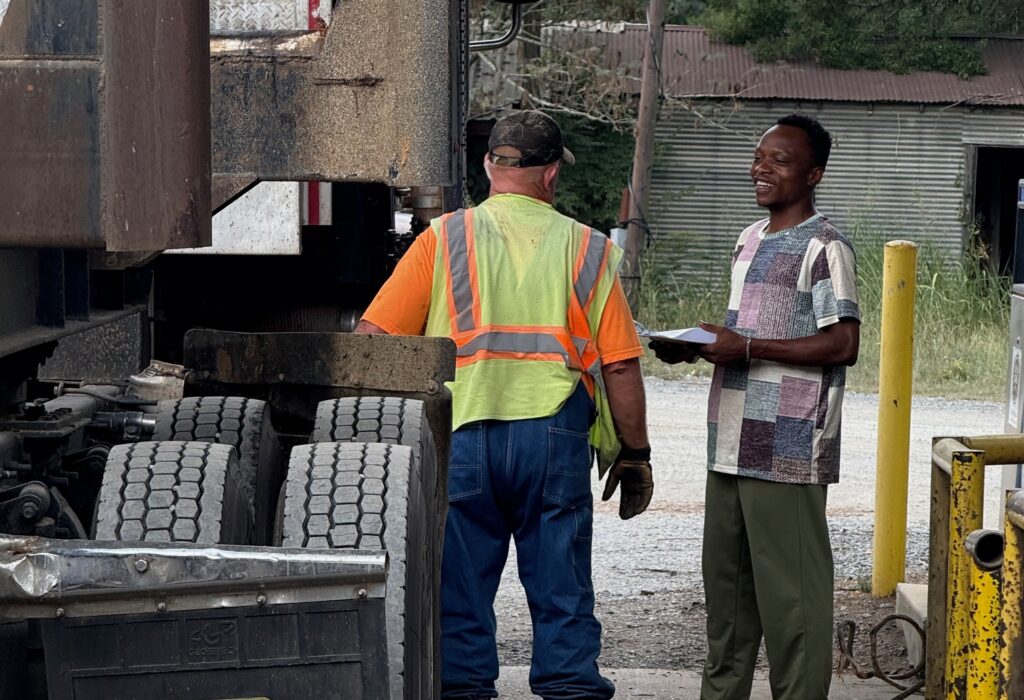
As part of an Auburn University Rural Partnership-funded study, College of Forestry, Wildlife and Environment graduate student Abu Tahiru interviews a log truck driver during a fuel stop.
Building a Resilient Forest Economy
Researchers in Auburn University’s College of Forestry, Wildlife and Environment (CFWE) are working to better understand—and help solve—the day‑to‑day challenges facing Alabama’s forestry and forest products industry.
Through funding from Auburn’s Rural Partnership Institute (AURPI), a CFWE Forestry Team led by professors Marissa “Jo” Daniel, Richard Cristan, Adam Maggard and Lana Narine is studying how regulatory changes, operational pressures and new technologies affect loggers, truck drivers, mills and forest‑based businesses across Alabama and the Southeast.
For many in the industry, these challenges show up on the ground: navigating changing air quality regulations, deciding whether costly new equipment is worth the investment or managing truck weight limits that affect hauling efficiency. The research team is generating practical, data‑driven insights designed to support safe, efficient and financially sustainable forest operations—while helping policymakers and industry leaders better understand how regulations play out in real working conditions.
Improving Efficiencies
“Improving the efficiencies of forest operations is an integral component of our work,” said Daniel. “If we want a strong, resilient forest economy, we have to understand what operators are actually facing and help them better adapt to a changing market and regulatory landscape.”
To do that, the researchers, including graduate students Abu Tahiru, Hannah Mayo and Manisha Subedi, have conducted interviews and surveys with forestry stakeholders across the supply chain. These conversations focus on issues such as how businesses decide whether to adopt new harvesting or trucking technologies, how compensation structures affect logging businesses and third‑party truck drivers and how the forest industry is being impacted by the U.S. Environmental Protection Agency’s updated National Ambient Air Quality Standards for fine particulate matter (PM2.5).
Delivering Practical Outcomes
“These stakeholder engagements have directly shaped both our research questions and our workforce development efforts,” Daniel said. “The industry is telling us what works, what doesn’t and where the biggest pressure points are.”
Current projects include studying the differences in how interstate and state highways are used for log truck transportation in Alabama, how truck weight limits affect logging businesses and drivers and what barriers—such as licensing requirements, insurance costs and equipment investments—make it difficult for new logging truck drivers to enter the profession. The team also aims to estimate logging equipment carbon emissions, diesel exhaust fluid use and fuel consumption—information that can help operators anticipate compliance costs and identify efficiency improvements.
The goal is to translate these findings into practical outcomes: clearer guidance for loggers and truck drivers, a better understanding of regulatory compliance costs and research results that can be turned into training materials and Extension programming.
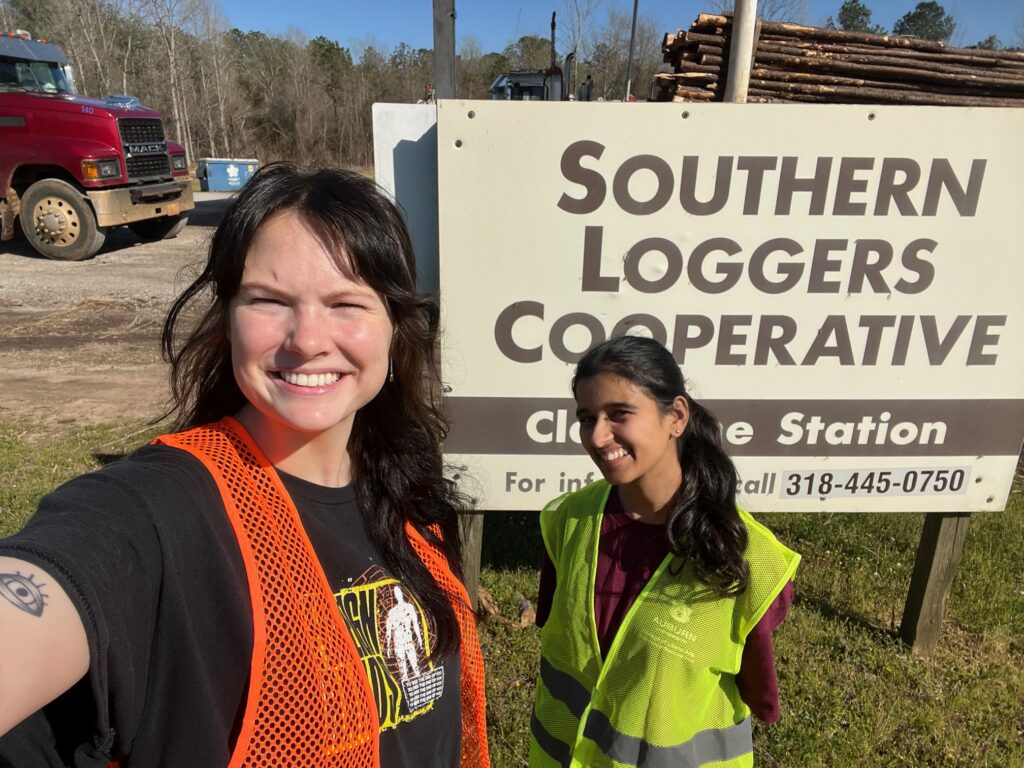
Graduate students Hannah Mayo and Manisha Subedi visit the Southern Loggers Cooperative to conduct survey interviews.
Training the Trainers
“Training the trainers” is foundational to this effort. Initiatives that have been carried out or are planned include graduate‑ and postdoctoral‑led applied research projects that directly involve collaboration with logging contractors, truck drivers, mills and industry partners. This survey and other interview‑based engagement expose students to real‑world operational decision‑making and the development of hands‑on training tools, including a whole‑tree harvesting simulation aimed at advancing logging workforce education.
“Ultimately, these initiatives are about building confidence and competence,” Daniel said. “That means improving technical skills, increasing awareness of regulations and helping current and future forestry professionals be better prepared for the realities of the job.”
Looking ahead, the team plans to launch new scale studies to support Alabama’s forestry and trucking industries, expand simulator‑based research to better understand truck performance and operator decision‑making and continue strengthening long‑term benefits for the workers, landowners and communities that sustain Alabama’s forest economy.
More information about Auburn’s Rural Partnership Institute is available at: https://eng.auburn.edu/bsen/research/aurpi/.
(Written by Jamie Anderson)