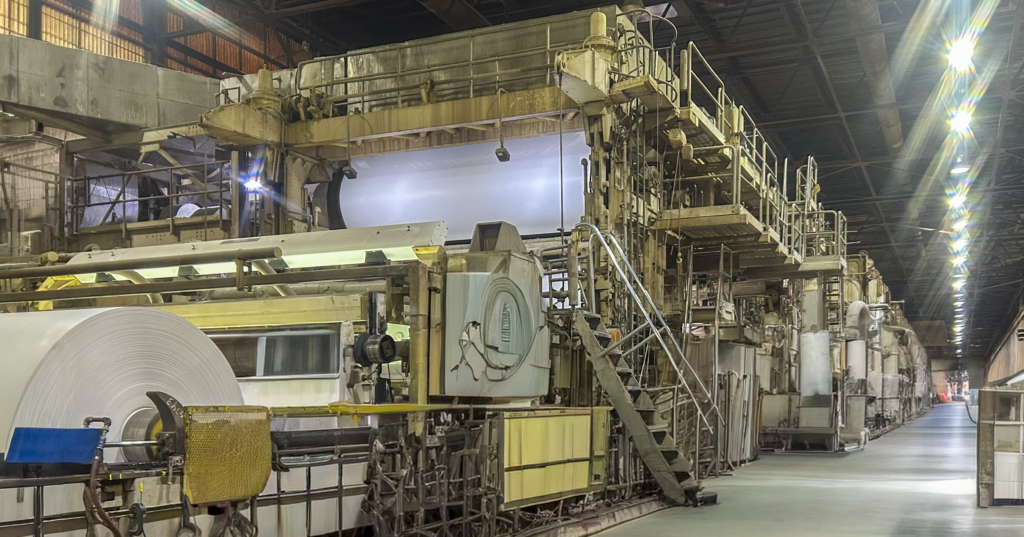
A large roll of containerboard moves through the production line at a South Alabama mill, where wood fiber is transformed into paper products used for packaging.
Project to lower emissions, reduce energy consumption and create value-added products
Auburn University is one of 56 institutions to receive $117 million from the U.S. Department of Energy (DOE) Office of Critical Minerals and Energy Innovation (CMEI) to help strengthen the competitiveness of key American industries through energy and cost-saving innovations. The selected projects will advance innovative solutions in trade-exposed industrial sectors, including chemicals and refining, iron and steel, food and beverage, pulp and paper and cement and concrete manufacturing.
Auburn’s project will specifically aim to develop novel dewatering processes for forest products and eliminate emissions from the wood-drying process, including volatile organic compounds (VOCs) and particulate matter, that will help the forest products industry decrease energy consumption and explore value-added byproducts, delivering affordable, market-ready solutions that strengthen U.S. energy security and support job creation and economic growth nationwide.
The forest products industry, producing nearly $300 billion worth of essential products annually, including pulp, paper, packaging, plywood and lumber, and employing approximately 950,000 people nationwide, is the third-largest consumer of energy in the U.S. manufacturing sector, accounting for 15% of total energy use.
Although approximately 56% of energy use comes from renewable sources, the industry still consumes significant quantities of fossil-fuel-based energy, largely due to the energy-intensive thermal drying process used to dry industrial forest products, which releases VOCs from energy generation and forest products into the air.
The DOE-funded project, led by Yucheng Peng, an associate professor of sustainable packaging and bioproducts in the College of Forestry, Wildlife and Environment, will use pressurized carbon dioxide (CO2) to remove moisture from wood and other forest products.
“Using mechanical forces generated by CO2 phase change from the supercritical liquid to gas, water will be removed from the wood cell lumen and cell wall under a well-controlled process which simultaneously facilitates the collection of VOCs emitted in the process, improving air quality compared with traditional thermal-energy-based drying,” said Peng.
The novel method proposed by the project will provide opportunities to reduce thermal energy consumption, which is necessary to overcome the latent heat required to change water from liquid to gas and the heat of wetting the material, thereby removing water molecules that interact with forest product cell wall polymers.
Further, reducing energy consumption from dewatering operations and creating value-added products with enhanced performance will have cascading benefits to downstream applications that may manufacture higher-quality wood composites and pulp products, such as composites with improved adhesion strength and better fiber quality for papermaking.
This project is co-led by Zhihua Jiang, the Auburn Pulp and Paper Foundation Professor and director of the Alabama Center for Paper and Bioresource Engineering in the Samuel Ginn College of Engineering, and Brian Via, former Auburn Regions Bank Professor of Forest Products and now the director of the School of Packaging at Michigan State University.
A broad spectrum of forest products is encompassed in the project, including solid wood products derived from diverse wood species, wood composites and pulp and paper. Each principal investigator will lead research within a specific focus product dewatering process while actively collaborating with other team members to promote knowledge exchange, interdisciplinary innovation and the integration of expertise across product categories.
“In alignment with the DOE’s goal to help the most energy-intensive industries overcome barriers and benefit from the latest in technology innovation and strategic analysis, the team’s research will provide cross-cutting technologies that can be applied across the forest products industry,” said Janaki Alavalapati, the Emmett F. Thompson Dean of the CFWE.
Through funding allocations, public-private partnerships and direct technical assistance, the CMEI helps meet America’s skyrocketing energy demand, safeguard America’s energy security, reduce energy costs and facilitate the reshoring of domestic manufacturing.
Learn more about this initiative via the DOE’s recent publication: DOE’s Office of Critical Minerals and Energy Innovation Announces $117 Million to Strengthen America’s Industrial Sector | Department of Energy.