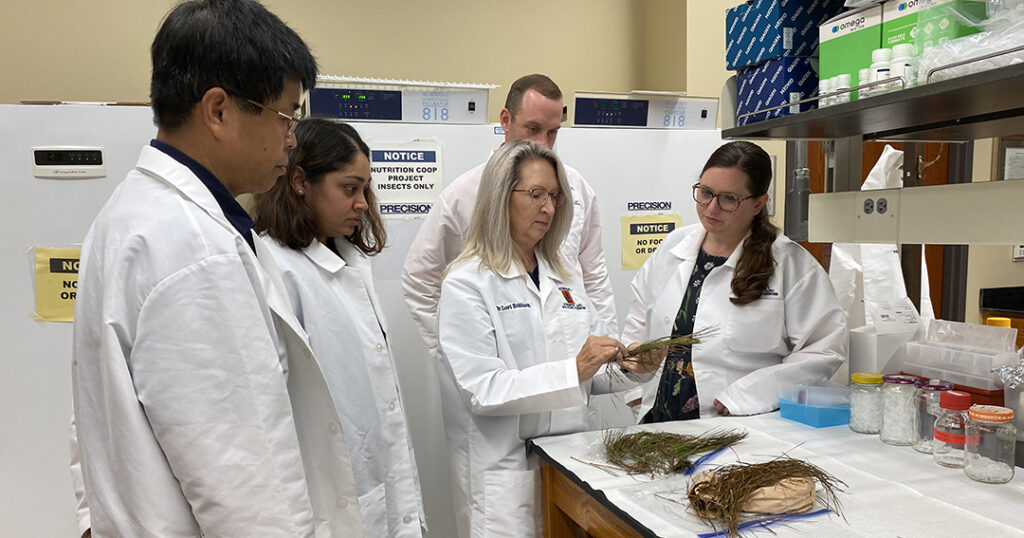
An Auburn University research team has completed the initial phase of its brown spot needle blight (BSNB) research study, delivering innovative tools and strategies to safeguard the region’s forest industry. Shown from left to right are the project team members, Joseph Fan, Lana Narine, Lori Eckhardt, J. Ryan Mitchell and Janna Willoughby.
Delivering actionable results
Auburn University has completed the initial phase of its brown spot needle blight (BSNB) research study, delivering actionable results to industry that will help tame the proliferation of the needle blight now decimating pine forests across the southeast.
A growing economic threat
Pine forests are essential to the Southeast’s economy, especially in Alabama, where forest products generate more than $12.5 billion annually and support over $1.5 billion in exports. However, this vital sector faces increasing pressure from invasive pests and diseases like BSNB. Currently affecting 58 of Alabama’s 67 counties, the disease poses a serious economic risk. Researchers estimate that if just half of the state’s susceptible loblolly pine trees become infected, losses could reach $2 billion. Nationwide, forest damage from pests and pathogens already costs an estimated $4.5 billion annually.
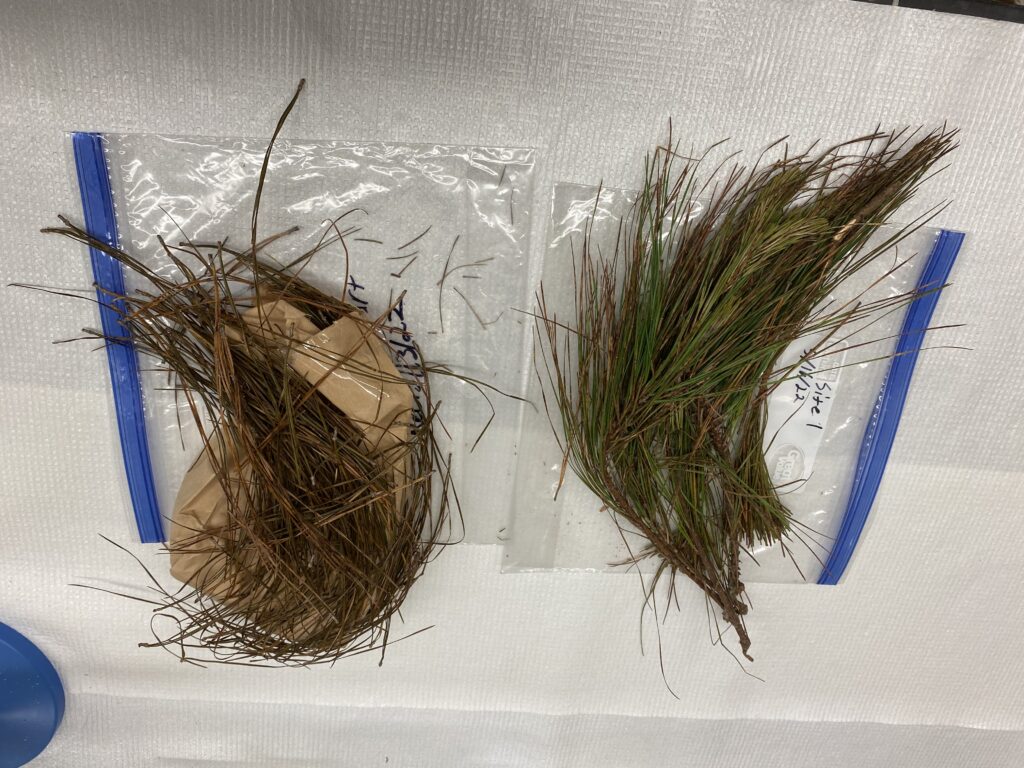
Discolored needles are the first sign of infection. Pine needles appear scorched by fire, even though there has been no burn.
To address this growing threat, Eckhardt and her colleagues—including CFWE faculty Lana Narine, Janna Willoughby and Joseph Fan—launched the study in 2022 with support from the U.S. Forest Service. During Phase I, which concludes in December 2026, the team established study plots across Alabama and trained a new generation of scientists, with doctoral students Jaden King, Swati Singh, Temitope Folorunso and Gabriel Silva leading various components of the study while mentoring undergraduate researchers.
Phase I reveals valuable insights
“The BSNB team produced a comprehensive, multi-year dataset across 22 plots, capturing tree growth, disease severity, physiological traits, environmental variables and spore dynamics,” said Eckhardt. “Early findings show that the disease severity increased most when it correlated with the stress level of the trees, evidenced by reduced growth and increased nutrient deficiencies.”
Lana Narine, an associate professor of geospatial analytics, led the geospatial component of the research effort that improved methods for studying the disease from above using drones and advanced imaging technology. The scientists collected detailed images of the landscape and then used machine learning algorithms to detect and analyze the disease more effectively. This approach helped them better detect where the disease is occurring and how severe it is over large areas.
“Using this method, we detected and mapped disease severity with over 90% accuracy,” said Narine, who mentors graduate researcher Swati Singh, whose work was central to investigating and reporting these findings. “This work creates the blueprint for a larger monitoring program. By proving how to accurately detect the disease, we now have the foundation to track its spread over much larger areas. This scale will help researchers and land managers identify problem areas more reliably.”
At the same time, Janna Willoughby, associate professor of population and conservation genetics, led the genomic and ecological investigations into the disease. With her guidance, the researchers made great progress in understanding the genomic and ecological complexity underlying needle blight symptoms, revealing that needle blight disease severity is influenced not just by a single fungus but by complex communities of fungi occurring together.
“Folorunso, Silva, and I studied nearly 100 fungal genomes, and the results suggest that how severe the disease becomes may depend on how many different fungi are present and how fungal communities differ among infected trees—not on a single “main” culprit,” Willoughby said. “Going forward, we will be digging deeper to understand how these fungi function under environmental stresses and which genes and pathways become active during infection, helping to explain why some infections are worse than others.”
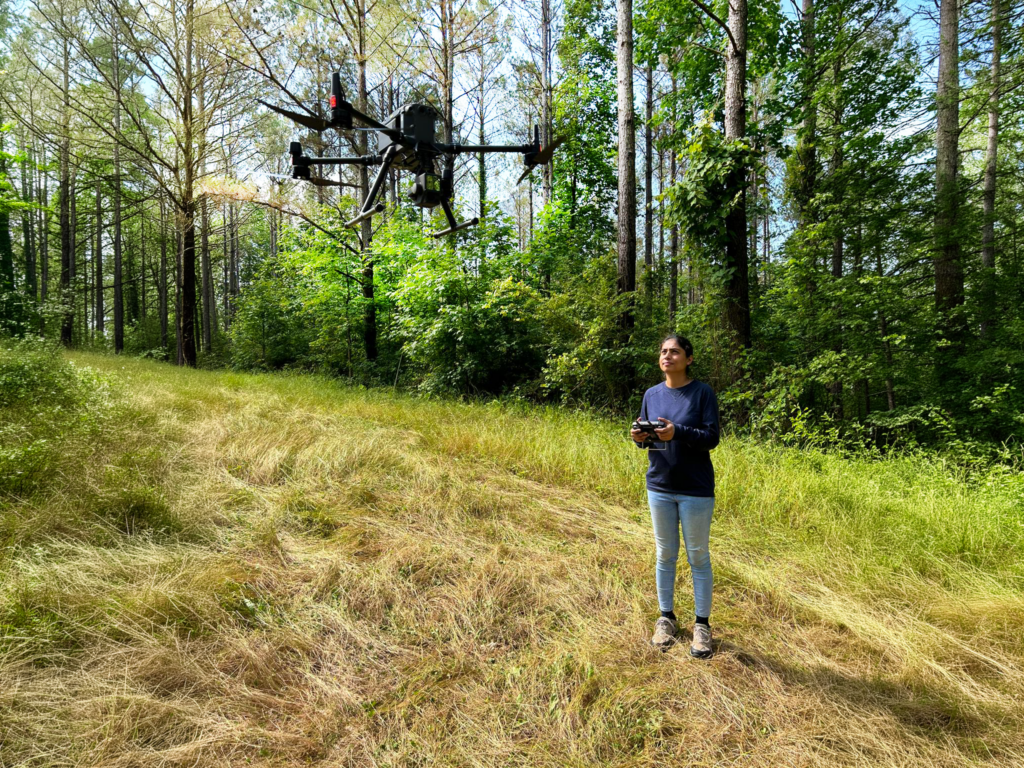
Swati Singh, a doctoral student in the CFWE, uses a drone and advanced imaging technology to detect needle blight.
Defining a systems-level mitigation strategy
“Overall, this study gives industry a much clearer picture of what causes needle blight and how it spreads, which is critical for managing it effectively,” said Eckhardt. “Instead of treating needle blight as a simple problem with a single cause, the research shows it is a complex disease involving multiple fungi that interact with each other and the environment. That deeper understanding will help avoid one‑size‑fits‑all solutions that may not work.”
Because the project produced strong datasets and new tools, Eckhardt says that landowners will now have better ways to detect and monitor the disease early. With accurate mapping and monitoring the team anticipates that land managers, growers and foresters will be able to identify high‑risk areas sooner, concentrate resources where they’re needed most and avoid unnecessary treatments in healthy areas.
“This systems‑level approach—looking at genetics, environmental conditions and disease patterns together—helps us to better understand why outbreaks happen in some places but not others,” said Eckhardt. “This supports smarter decision‑making, such as adjusting management practices, timing interventions more effectively and reducing conditions that allow the disease to spread.”
Further, Eckhardt says the team has laid the groundwork for practical prevention and control strategies. By understanding how multiple pathogens work together, industry can develop more targeted treatments, improved monitoring protocols and better long‑term management plans that reduce disease spread rather than simply reacting after damage has occurred.
Just as importantly, the publications and methods generated by the scientists will ensure that scientists and industry professionals can continue using and building on this work, ultimately supporting ongoing innovation, improving resilience and helping protect productivity and environmental health over time.
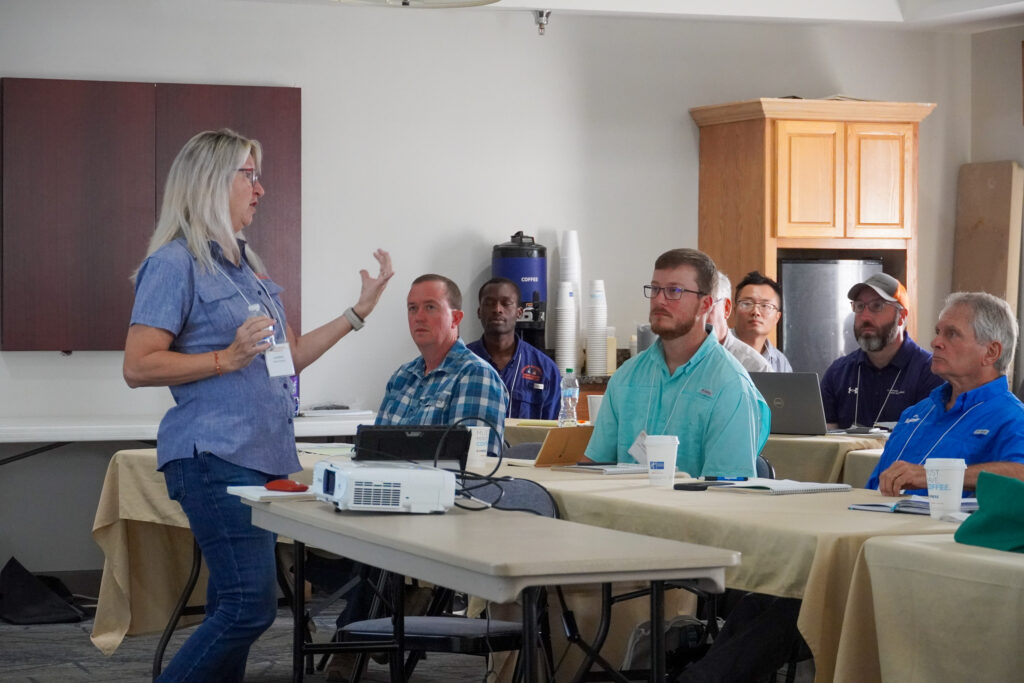
The outreach component of the project involves training educators and sharing findings with land managers to encourage real-world adoption.
Phase II expands monitoring, detection and forest health solutions
With additional support from the U.S. Forest Service (USFS) through the State of Alabama, the team will continue its research over the next several years.
Looking ahead, Phase II will expand the study with additional team members, including Hao Chen, assistant professor of forest genomics, and Annakay Newell, Extension specialist and assistant professor of forest health. This next phase will focus on understanding how environmental factors like climate and landscape influence disease spread, developing AI-driven monitoring systems using Earth observation data and identifying fungal traits that increase disease severity. The team will also prioritize outreach and education to ensure their findings are translated into practical tools for land managers.
“Ultimately, the work led by Eckhardt and her interdisciplinary team provides a clearer path forward for protecting pine forests, reducing economic losses and strengthening the long-term sustainability of the southeastern forest industry,” said Janaki Alavalapati, the Emmett F. Thompson Dean of the CFWE.
(Written by Jamie Anderson)