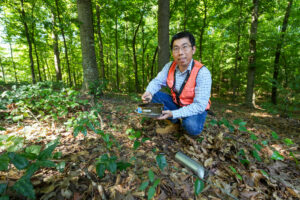
Yang Yang captures soil samples for research in a local Alabama forest.
At the core of all living plants, including trees, soils and root systems are fundamental components of a successful species. As one can imagine, unearthing these terrestrial ecosystems for study can be laborious and often requires time, travel and specialized equipment. A professor at Auburn University’s College of Forestry, Wildlife and Environment (CFWE) is changing the way that students can learn about soil science, literally from the ground up.
Yang Yang, CFWE assistant professor of forest soils and biogeochemistry, says that traditional soil teaching methods heavily rely on textbook diagrams and field trips. In Yang’s experience, there are more efficient techniques for instructing soil ecosystem classes by presenting soil composition in a different format.
To bring native Alabama soils into the classroom, Yang intends to preserve them using monoliths, vertical underground collections capturing layers, textures and colors of local earth. Maintaining the original mineral composition, roots and horizon colors, these tools are perfect for instruction, allowing for more frequent hands-on study of soil layers.
“While field trips provide valuable exposure, they often allow only brief observations of soil profiles and do not enable repeated study of soil horizons or structures,” Yang said. “Providing opportunities for repeated, hands-on interaction with real soil profiles can greatly improve student comprehension and engagement.”
Funded by The Daniel F. Breeden Grant, which supports teaching and learning projects directly benefiting Auburn instructors, the soil monolith initiative will provide meaningful and lasting benefits to the university’s mission, according to Adam Maggard, CFWE associate dean for academic affairs and Harry E. Murphy Associate Professor of forest systems management.
“The project will directly support instruction in courses such as Introduction to Forest Nutrients, Forest Soils, Basic Soil Science and Soil Chemistry, which collectively serve more than 130 students annually,” said Maggard. “The resulting monolith collection will become a long-term teaching resource that can be incorporated across courses and departments while supporting Auburn’s commitment to experiential and inquiry-based learning.”
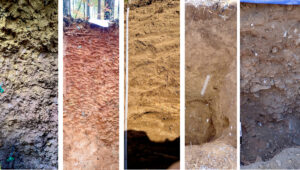
The completed soil monoliths will display many different soil types taken from unique locations.
Beginning in September 2026, Yang and a cohort of undergraduate students will select sample sites for the monoliths that will canvass two primary transects: a north-south transect showcasing meteorological contrast across Alabama and a wildland-urban transect showcasing land use and vegetation types, using the USDA Web Soil Survey to confirm accurate documentation of soil profiles.
“We aim to leverage the students’ home areas for soil monolith collection to produce at least 20 soil monoliths,” Yang said.
Each monolith will be approximately a foot long, 4 inches wide and collected at 2 to 3.5 feet in depth. After the samples are taken, each one will be preserved in a laboratory and carefully processed and labeled, ensuring longevity for display and instruction.
Yang adds that the impact of the soil monoliths on student learning will also be evaluated using a three-prong approach. First, students involved in the construction of the displays will complete hands-on learning surveys, while students unfamiliar with monoliths will be quizzed after two forms of forest soils education: one using only online diagrams and photos, and another using the monoliths paired with two weeks of related lectures. Thirdly, instructors using the displays will record classroom performance by documenting activity, engagement and overall success for each student group.
From under students’ soles to being held in their hands during detailed classroom discussion, Yang is eager to complete this soil science initiative, providing new learning experiences for Auburn. Collectively, this will prove to be another example of the CFWE’s commitment to quality instruction and student outcomes.
“This project represents an innovative approach to strengthening experiential and place-based learning at Auburn while creating a durable instructional resource that will benefit students across several natural resource disciplines,” Maggard said.
Yang is currently recruiting two undergraduate students for the fall 2026 and spring 2027 semesters. One student will focus on constructing monoliths while the other will work on various lab experiments to examine soil texture, nutrients, microbes and microplastics. Interested students should contact Yang Yang at yangy@auburn.edu before each semester begins. The monolith project is anticipated to be completed at the conclusion of spring 2027.