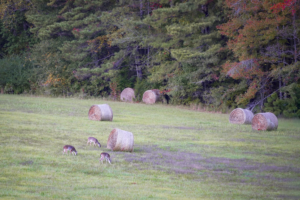
White-tailed deer feed in the late evening at an enclosed facility in eastern Alabama.
Chronic wasting disease (CWD), one of the most significant diseases affecting white-tailed deer, has proven to be one of the most fatal neurological diseases threatening North America’s wildlife populations. Once established in a deer population, it is extremely difficult to eliminate. An Auburn University disease ecologist and his colleagues have developed a new simulation modeling tool that can help identify captive facilities with undetected CWD, helping wildlife agencies target surveillance efforts and make more informed disease management decisions.
CWD remains one of the greatest challenges facing the future of white-tailed deer management and conservation and, by extension, the North American Model of Wildlife Conservation, which relies heavily on healthy, sustainable deer populations. Captive deer herds face an especially high risk of CWD because they are often kept at higher densities, have frequent contact with one another and are regularly moved between facilities. The disease is known to impact cervids of the biological deer family, Cervidae. Like mad cow disease, which reached its peak in the early 1990s, CWD is a fatal and untreatable neurodegenerative disease belonging to the same family of disorders known as transmissible spongiform encephalopathies.
Aniruddha Belsare, an assistant professor of disease ecology in Auburn’s College of Forestry, Wildlife and Environment (CFWE) and College of Veterinary Medicine, has assisted in the development of innovative computer modeling tools that can help wildlife agencies better detect, track and manage the growing threat of CWD. Traditionally, testing methods rely on examining tissues collected from deer after death, although testing in live animals is now becoming increasingly available. However, the effectiveness of surveillance depends heavily on how many deer from a herd are actually tested. This is especially important during the early stages of a CWD outbreak when only a few deer may be infected and not show any signs of disease.
The primary challenge for wildlife agencies is that, in many captive facilities, only a small portion of the herd is tested each year. Consequentially, a “CWD not detected” result does not necessarily mean the herd is free of the disease. Infected deer may have been missed because too few animals were tested. This uncertainty makes it difficult to determine how much confidence to place in negative test results, which places facilities at greater risk of harboring undetected CWD.
“CWD is one of the most significant challenges facing the long-term management and conservation of deer and other cervids in North America,” Belsare said. “Early detection is critical for limiting disease spread, yet surveillance programs often face the challenge of interpreting ‘CWD not detected’ results, particularly when only a small proportion of animals are tested. This uncertainty is especially important in captive cervid facilities, where high animal densities and movement of deer among facilities can increase the risk of disease transmission.”
Cervids infected with CWD experience progressive neurological decline and symptoms of coordination loss, weight loss and significant behavioral changes. Eventually, the deer will succumb to the disease and perish. Since there is no cure for CWD, the only efficient defense against widespread infection is early detection and predictability.
Belsare, who served as principal investigator on the research project supported by the U.S. Department of Agriculture Animal and Plant Health Inspection Service, and Lauren Wakefield, a graduate student in CFWE, recently published a study with colleagues from the Texas Parks and Wildlife Department titled, “A Simulation-Based Approach to Strengthen Chronic Wasting Disease Surveillance in Captive Cervid Populations.”
Published in PLOS ONE, a peer-reviewed, open-access scientific journal of the Public Library of Science, their publication described the development and application of an agent-based simulation model dubbed CapOvCWD. This model is designed specifically to support CWD surveillance efforts in captive deer populations.
“The model integrates herd demographics, deer movement histories and CWD testing records to estimate the probability that CWD would have been detected if it were present in a facility,” Belsare said. “By quantifying the likelihood of undetected infection, CapOvCWD helps wildlife agencies interpret surveillance results, prioritize facilities for enhanced monitoring and allocate limited surveillance resources more effectively.”
Instead of viewing testing for CWD as a positive or negative result, this new tool also allows wildlife conservation professionals to simulate risk levels in captive cervid facilities and prioritize where resources should be allocated in real time to educate and survey for the disease. For example, in a real-world scenario using data from 23 captive cervid facilities in Texas, Belsare and the research team were able to incorporate more than 20 years of CWD testing records using the CapOvCWD model to evaluate the effectiveness of CWD surveillance. Four facilities identified by the model as having consistently low chances of detecting CWD through their existing surveillance efforts later reported CWD cases in 2022 or after. This data highlights the practical value of the team’s approach: to provide a consistent way of comparing monitoring efficiency, identify where CWD may be more likely to go undetected and prioritize additional surveillance where it is needed most.
“A distinguishing feature of this work is its participatory modeling approach, which incorporates the expertise and experience of wildlife biologists, deer managers and modelers throughout the model’s development and application,” Belsare said. “The resulting framework provides a practical, science-based decision-support tool that can help standardize surveillance efforts across captive cervid facilities and promote more sustainable, efficient and risk-based CWD management strategies.”
Belsare and his team stress to wildlife managers that negative CWD tests should be interpreted cautiously. Some deer facilities that have never recorded a positive test result may still contain the disease if testing efforts have been limited.
“This research exemplifies the CFWE’s pledge to address complex conservation challenges through innovation and collaboration,” said Janaki Alavalapati, the Emmett F. Thompson Dean of the CFWE. “By developing tools that improve our ability to detect and respond to CWD, Dr. Belsare and his colleagues are providing wildlife managers with actionable science that can help protect deer populations and strengthen conservation efforts across the country.”
Ultimately, this success by Belsare and his fellow researchers unveils more applications for model-based conservation methods across the globe. By using innovative data tools and practical, scientific practices, institutions like Auburn are committed to finding solutions to society’s most difficult challenges. In the modern era of wildlife disease ecology, scientists like Belsare understand that it has never been more important to stay on the cutting edge of detecting the undetected.