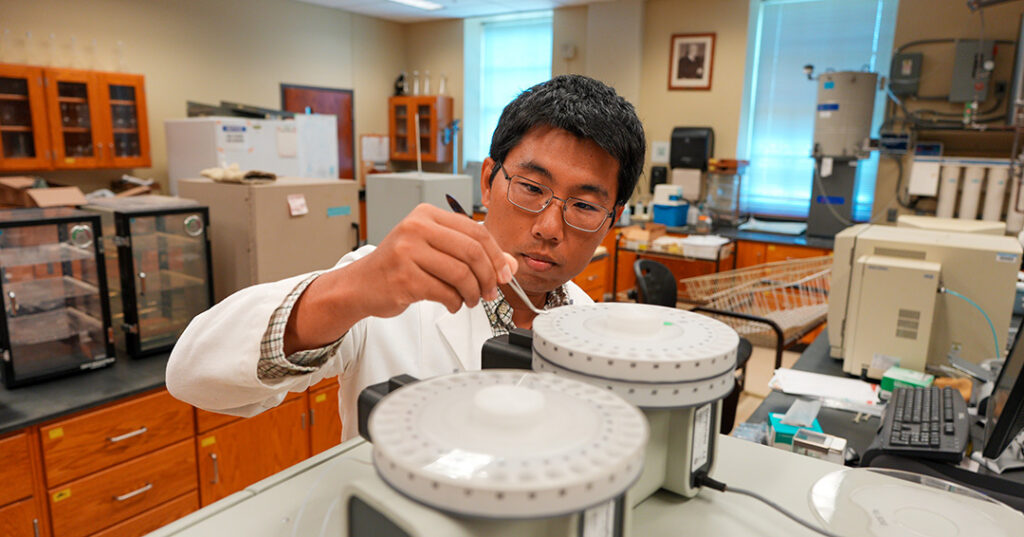
College of Forestry, Wildlife and Environment assistant professor Yang Yang loads soil samples into an Elemental Analyzer to generate nutrient data for AI-based subsurface biogeochemical modeling.
An Auburn University professor has partnered with scientists at the U.S. Department of Energy’s (DOE) Oak Ridge National Laboratory to develop a next-generation artificial intelligence (AI)-driven modeling framework that will improve our understanding and predictive ability for assessing underground processes across a wide range of ecosystems.
The multi-institutional project is funded by a competitive grant through the DOE’s Genesis Mission initiative, a U.S. government-led effort to leverage AI to address STEM challenges impacting quantum computing, fusion energy, materials science, healthcare, pharmaceuticals and advanced manufacturing.
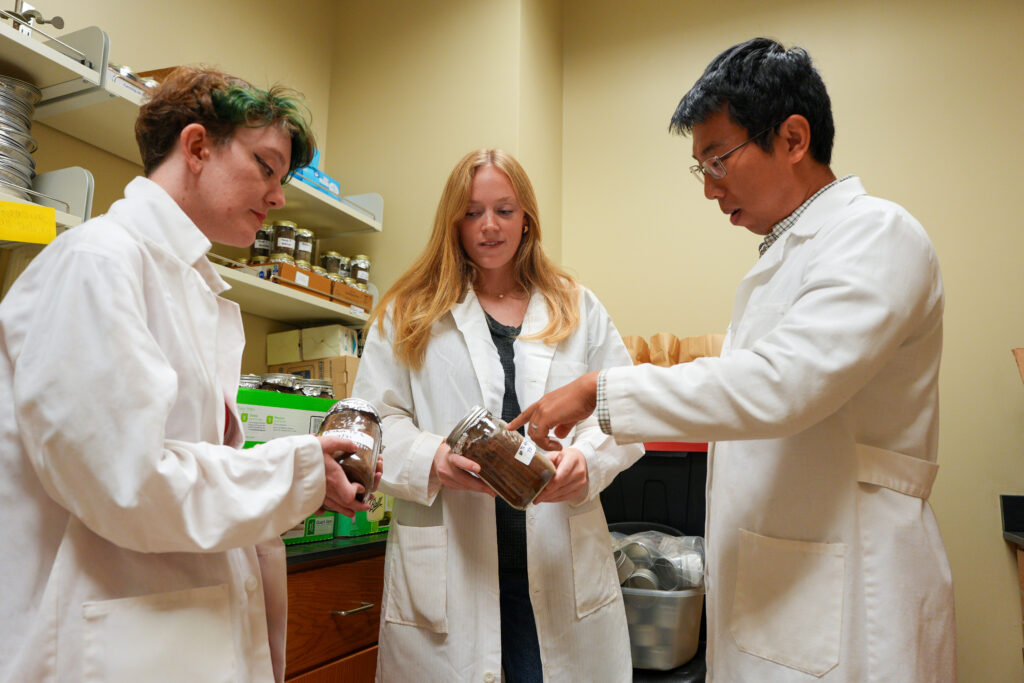
Yang Yang, shown with graduate students Marilee Hoyle and Kendall Brents, examines subsurface soil samples to characterize biogeochemical properties.
Integrating subsurface dynamics
Yang Yang, an assistant professor of forest soils and biogeochemistry in Auburn’s College of Forestry, Wildlife and Environment, will lead the effort to combine process-based model simulations and experimental data, along with field and laboratory observations that will be used to train a new AI modeling framework and to validate and interpret the AI outputs, ultimately improving its accuracy.
It remains challenging to detect critical minerals and other natural resources because complex interactions among soil, water, biological activity and chemistry influence how these resources develop and move across landscapes over time.
The current DOE models are computationally intensive and struggle to represent the diverse processes happening beneath the ground. Nor do they fully integrate the extensive data scientists have collected, including information about soil conditions, temperature, moisture, microbes and organic matter. As a result, these models can miss important factors that influence how ecosystems function below the surface.
“These limitations hinder our ability to accurately predict how water, carbon, nutrients, contaminants and critical minerals move and transform under changing environmental conditions,” said Benjamin N. Sulman, a senior research and development staff member in the Environmental Sciences Division at Oak Ridge National Laboratory who serves as the principal investigator for the project.
Training the model
By combining large amounts of data on underground moisture, temperature and chemical processes, the team will use AI and advanced modeling approaches to improve the predictability of subsurface processes. The result will be faster, more accurate models that can be integrated with other tools for understanding land, water and ecosystem dynamics.

AI-enabled predictive modeling of the subsurface critical zone across variable U.S. landscapes. Credit: Andy Sproles/ORNL, U.S. Dept. of Energy
Improved modeling capability will yield significant benefits for energy, environmental management and natural resource sustainability while reducing the computational costs associated with large-scale Earth system modeling.
“These advances will support more effective management of water and land resources, enhance climate resilience, improve environmental remediation and ecosystem conservation and provide faster, more cost-effective tools for scientific research and decision-making,” said Yang.
The Genesis Mission project, titled “AI-enabled Subsurface Biogeochemical Modeling,” was one of 278 projects funded from a pool of 5,000 applications received by the DOE. Project partners also include the University of California, Riverside and the Lawrence Berkeley National Laboratory.