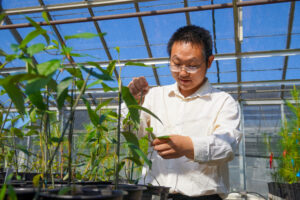
Hao Chen observes poplar trials at the Auburn University Plant Science Research Center.
An Auburn University professor is using genomics to uncover and harness the genetic traits of drought-tolerant species to map the future of more sustainable and resilient bioenergy resources.
Auburn College of Forestry, Wildlife and Environment Assistant Professor Hao Chen, is an expert in forest genomics. He focuses on molecular, biochemical, genetic and genomic research, as well as the skills to integrate various omics data to model plant processes, including the transcriptional regulation of wood formation.
Recently, Chen’s research has been based around poplar trees, a critical bioenergy crop as designated by the United States Department of Energy (DOE), the federal agency tasked with ensuring the country’s energy and environmental security through science and technology. His latest project will address the fundamental challenges of gene-regulated drought tolerance and woody biomass production in poplars.
As part of the DOE’s Joint Genome Institute, or JGI, 2025 Functional Genomics Awards, this study will directly support the DOE’s Biological and Environmental Research mission to create resilient bioenergy feedstocks, materials that are typically used to fuel machinery and industrial practices. Chen will be the principal investigator (PI) for this project with assistance from CO-PIs and professors Jack Wang, North Carolina State University, and Zongliang Yue of Auburn’s Harrison College of Pharmacy.
“Understanding the transcriptional regulatory network underlying these traits is essential for developing resilient bioenergy feedstocks that can thrive under climate stress while maintaining high biomass yields,” Chen said.
The researchers’ work will utilize DNA affinity purification sequencing (DAP seq) technology to observe poplar trees’ transcriptional regulatory network within their cross-section, a downward view of a tree’s stem structure. By using this method, Chen and his team will be able to identify the DNA transcription factors, or “genetic switches,” that enable poplars to be drought resilient while still maintaining steady growth rates.
A successful project will yield a genetic ‘map’ that will showcase how these genes can potentially be engineered in other DOE-designated critical bioenergy species.
“Environmentally, this research will reduce the vulnerability of bioenergy systems to climate variability,” Chen said. “Economically, it will help ensure stable biomass production for bioenergy and bioproducts, reducing reliance on fossil fuels.”
Chen adds that this effort will also serve as a unique platform for recruiting and training graduate students studying genomics and bioenergy-related research. In turn, this project supports workforce development within the fields of biotechnology and genomics while preparing the next generation of scientists for DOE mission areas.
“Dr. Chen is the leading voice of the CFWE’s forest genomics research and instruction program,” said Janaki Alavalapati, the Emmett F. Thompson Dean of the CFWE. “We are proud of his work and the contribution he is making to renewable energy security and sustainable forestry.”
Learn more about the CFWE’s forestry research on its website.